A new hope for the human race.
Florida is nice. It's 80 degrees out, sunny, the clouds (when they come) blow over quickly. The wildlife is raucous and reassuringly abundant. At our "Inn," an aging family resort near New Smyrna Beach, pieces of glitter-bedecked, mixed-media shell-art hang in the bedroom and the sign out front eagerly declares, "Bikers Welcome." This is VacationLand, where older white men come to golf and younger men in monster trucks drive down Main Street, like they were just anyone.
I wouldn't want to be anywhere else right now, and not because of the pleasant contrast between VacationLand and Boston, ever cold and austere, ever proper and self-aware of its appearance. Not because this place feels so isolated, making sussurations from the shouts of overseas revolt, the internal US budget debate that smacks of, "let them eat cake," and the harmful mouth-noises of conservative Congressmen defying the limits of government regulation to interfere with my body and self-determination. We came down for one reason only: to watch the launch of STS-133, the last mission of Space Shuttle Discovery to the International Space Station.
When you ask anyone who's been to a shuttle launch, they always speak of the experience as awesome, fantastic and amazing. They talk about the fire, the smoke and the sound in such vague and grandiose terms that when you have grown up so far from the space coast, that language brings to your foremind the videos of a shuttle being accelerated up past the atmosphere by two tanks of thermite generating 6.6 million pounds of thrust. Despite understanding that I'd be at least six and a half miles out from Launchpad 39A - several miles outside of the kill zone - I imagined that the launch would leave me with retinal and auditory damage, with jellied nerves and that "what just happened," feeling that you get when you get caught in a explosive shock-wave. I expected physical, visceral awe. I came away with something very different.
We got to Kennedy Space Center at 9:15, just before the posted arrival time on our parking placard. We had Orange launch view tickets - NASA causeway - and hours to kill before we could catch a bus out to the base. The crowd was self-selected to be politely excited, uncomplaining when queuing up for everything from buying coffee to waiting in lines to get into lines (to get onto buses), navigating the gift shop for mementos and shepherding children dressed in astronaut jumpsuits. We came from everywhere - Europe, Australia and all over the States - there were children and families, the severely elderly and disabled, and we were all politely tired, thrilled, excited and quiet. Despite my jokes, there was no one shouting, "America! Fuck, yeah!" There was no shoving or argument. I heard precisely one person yell at his children, and the surrounding crowd looked at him in censure.
Many present had tried to see Discovery fly, first in November and again in December. Those who had been to other launches talked about them. We compared notes on the different class of launch tickets in order to figure out which vantage point we'd eventually get to. In our small talk, we were all familiar, none of us strange. "How far did you come? Are you excited? Is this your first time? Are you in astronautics? How long have you liked space? Excuse me, am I in the right line? I hope she goes up today..."
By 12:30 we had made it onto a bus. By 1:00 we were on the road towards the causeway, shouting our bus number and craning our necks to watch the vintage AstroVan speed by with its police transport, carrying the astronauts out to the shuttle launchpad. By 1:30 we were carrying chairs, our food and my cameras out as far back up the road as we could and still stay within the protective borders of the yellow groundskeeping line (I hear it has magical powers at repelling alligators*). We set up just to the left of the countdown clock at Station Foxtrot, in front of the bleachers that people sat on to watch the Apollo launches that flung men to the moon, and we waited.
We really do send men to space by understanding the physics of a slingshot - really. The shuttle is a stone with a gravity well to contend with, but she still flies by the virtue of raw power pointed in the right direction at the right moment and it takes all of our ingenuity to make that happen safely and repeatably. This is the awesome nature of space flight that weighed on us while we sat in the sun, praying the clouds would move, talking with strangers and watching the countdown clock. We waited with the sense that everything must be perfect, or Discovery wouldn't make it.
I passed my binoculars up and down the row, so we could see Discovery sitting on the pad, free from her preflight cocoon. The broadcasters piped chatter on the comm loops through to the loudspeakers, and so we heard the anxious voice of a young man when the adhesive from the arm used to hold the door during sealing pulled off part of the ceramic coating of a tile. Once he was talked down through the procedure to put an epoxy seal over the tile, and received confirmation that the repair was appropriate, Rob joked about that moment being one of crowning glory for the engineer who, in the 1980s, wrote the procedural manual to determine what an appropriate repair would be for damaged door tiles at the 20 minute mark in the launch count-down. We laughed about how, now that foreseen had happened that, for the rest of the mission, Engineer Dan would be on the edge of his seat, nerve-wracked, waiting for confirmation that his procedural guideline for the repair was, in fact, adequate. The announcer was careful to never imply that the launch was golden, his language carefully framed to seem confident while failing to actually be confident.
NASA is realistic enough to lack hubris about the matter of sending men and material into orbit. Every proclamation of "Go, Discovery!" meant to get us excited came out falling and flat. NASA is too honest to ever have a major role in national propaganda - it needs someone less truthful and cautious to be bombastic on its behalf.
As the countdown clock relentlessly decremented, the crowd's anxiety about the launch built. Apparently everyone had followed NASA directions to "Stay with your group," perhaps too closely, because the crowd in front of the launch clock was sparse and the bleachers were half-empty. We had room to lay about, play catch, breathe and be alone, while just a quarter mile down the causeway the throng grew to the thousands. Rob quietly joked about the history of space flight and its engineering; about how the four redundant IBM computers had a backup from a third vendor, who's only call to action would be to return a computational result in the event that all four computers threw an error; about the switched backup battery arrays; about the years of procedural and engineering work where the sole goal was to save a mission from some potential yet impossible to predict, unarguably fatal error. Implicit in our discussion was the sense that the space program is unappreciated, undervalued, oversimplified and taken for granted by so many - that we as a populace begin to forget the cost, complexity and effort required to send humans into space.
I fiddled with my cameras, propping up my Yashica for a multiple exposure, because I didn't trust myself to hold it steady. I swapped lenses in and out of my FE2, metering the sky, watching pelicans dive, settling on the one that would give me a magnified view of the launch. We ate sandwiches. The binoculars were passed up and down the line of chairs. We joked. We fidgeted. We waited.
During the hold preceeding the 9-minute countdown, the poll from weather had just come back as "green to go," and the crowd had begun to cheer when a choked-up technician came on the loop sounding like an adolescent boy - "Eastern Range is a no-go." There was some debate to continue the preparation for launch and conduct the system polls to give the RSO (Range Safety Officer) and his group time to troubleshoot, "Sir, do you have a problem with continuing the count-down until the 5-minute mak to give the RSO time to work their problem?" "I have zero problem with that." So when the countdown started again, the crowd preemptively cheered during every "go for launch," that came in response to the system polls -- just like in the movies. Yet, the voice from the RSO anxiously maintained that the display for the Eastern Range was still no-go. When everything stands against the survival of your vessel, safety checks are critical. The door seal is critical. Airspace management is critical. Visibility is critical. Some things, like an epoxy coating, can be fudged for launch (and suggestions were made to the effect that perhaps the RSO wasn't having a real problem? could they push it to after launch?) but the Range Safety Officer is responsible for watching and making sure no craft or obstacles stand in Discovery's path over the Atlantic (the Air Force Eastern Range). These internal arguments on the loop echoed out over the loudspeaker while we listened. Then, during the second hold at T-minus 5 minutes, the announcer began to count down the precious little time remaining in the launch window. The thousands of us were silent, waiting. Less than thirty seconds before the launch window expired, the RSO reported green and go for launch. Then the validation report. The confirmation from the mission commander came with less than two seconds to spare and the T-5 minute countdown resumed. That was the moment of real release. Five minutes later Discovery was on her way.
I want to say the cheer was deafening.
To be honest, you have had a more overwhelming sensory experience if your high-school basketball team made it to the state semi-finals when you were in pep-band. You have been more concussed at an air show.
The crowd was not raucous -- we were admiringly earnest. When we first had liftoff, you could not see Discovery for all the white steam and smoke. As she rose, you could not make out the ship because her size was nothing compared to the hundreds of feet of flame that propelled her enormous mass up -- constantly, relentlessly and impossibly up. Then came the roar. From six miles back, all that heat and fury looked and sounded, for all the world, like a bottle rocket lifting off in slow motion. Discovery veered to turn out over the Atlantic as her smoke rose up. We lost sight of her in the clouds. The column of smoke began to dissipate. She reached the point of no return for landing back at Cape Canaveral. She passed the point of no return for emergency landing in Europe. A few minutes later, Discovery was traveling faster than 4,000 mph and had made it to orbit when the mission commander came over the radio, "It's good to be here."
The shuttle had made it to space and the astronauts were unbuckled and looking out the view ports before we had even finished folding up our chairs. Wrap your mind around that. Humans had once again done the impossible. I did not have to be concussed by a sonic boom or blinded or burned by heat waves to be completely overwhelmed -- and dumbstruck I was -- because the enormity and improbability of NASA's accomplishment was enough.
Human ingenuity - fuck, yeah.
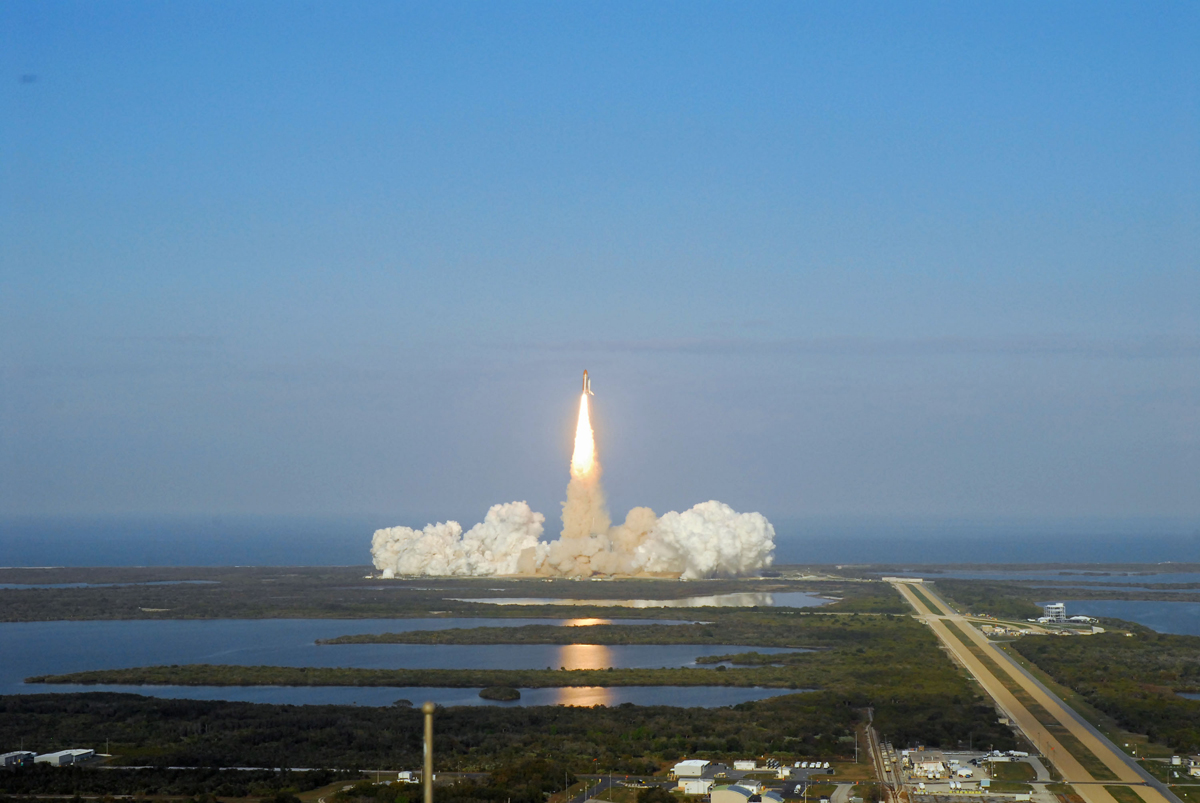
* KSC has the best signage -- stuff like: "Warning - these drainage ditches are infested with poisonous snakes." Infested! It makes a carefully regimented decision sound like an unavoidable situation to the un-savvy. They could post signs to the effect of, "Our military base doubles as a national wildlife refuge - please enjoy the roseated spoonbills and watch out for those members of the wild kingdom who will gladly fuck you up," but they don't.
** Also Also! This photo was taken by a NASA staffer Jeff Marino. Follow the link to the image hosted on "space.com," eh?
** Also Also! This photo was taken by a NASA staffer Jeff Marino. Follow the link to the image hosted on "space.com," eh?


1 comment:
You were there too? Excellent. I was offsite.
Post a Comment